
The warehousing and storage market size has reached to $713.06 billion in 2025 and expected to grow to $1037.33 billion in 2030 at a compound annual growth rate (CAGR) of 7.9% (Warehousing And Storage Market Report 2026, Share And Growth). In the US, there were over 31,000 third-party logistics warehouses operating in 2023, handling 15% of all US imports. Asia-Pacific region accounted for 42% of the global warehouse space demand in 2023, driven by e-commerce expansion in China and India (https://gitnux.org/warehouse-statistics/). The growth in the historic period can be attributed to expansion of organized retail supply chains, growth of manufacturing output, increasing demand for bulk storage facilities, rising globalization of trade flows, and development of industrial logistics parks.
Warehouse picking operations are at the heart of modern supply chain performance, directly influencing how quickly and accurately materials, components, and customer orders are fulfilled. They form a critical part of overall warehouse and distribution center efficiency, ensuring smooth movement of goods through the supply chain across manufacturing, retail distribution, and aftermarket service industries. In today’s highly competitive environment, even small inefficiencies in picking can lead to delayed shipments, increased operational costs, reduced customer satisfaction, and broader system-level issues such as inventory inaccuracies and production delays. As industries continue to face growing pressure for higher productivity, shorter lead times, and better resource utilization, improving efficiency has become a strategic priority. This makes it essential for organizations to explore advanced approaches such as simulation to better understand, analyze, and optimize warehouse operations before implementing changes in the real system.
Key Challenges in Warehouse Picking and Operations
Modern warehouses operate in highly dynamic and demanding environments where maintaining efficiency, accuracy, and operational consistency has become increasingly difficult. As order volumes grow and supply chains become more complex, warehouses face several operational challenges that directly impact productivity, inventory reliability, and customer service performance.
Inventory accuracy is one of the biggest challenges we face. Due to reasons such as manual inventory count errors, misplacement of products, inaccurate receiving processes, and inconsistent inventory updates, many warehouses experience discrepancies between recorded inventory levels and actual inventory availability. These errors can lead to order fulfillment delays, stockouts, inventory backlogs, and reduced operational transparency.
Another major concern is labor shortages and workforce management. Warehouses often struggle to recruit and retain skilled labor, especially during peak seasons and periods of high demand. Managing workforce allocation across multiple zones, shifts, and operational tasks adds further complexity to daily operations. Rising labor costs also continue to increase operational pressure on warehouse managers.
Space utilization and warehouse layout constraints present additional operational difficulties. Poorly designed warehouse layouts, inefficient aisle structures, and underutilized storage areas can increase travel distance, reduce accessibility, and create congestion during picking and replenishment activities. Fixed storage locations and inflexible layouts further limit operational adaptability when inventory profiles or demand patterns change.
Warehouses are also heavily impacted by demand volatility and seasonal fluctuations. Sudden spikes in order volumes, promotional campaigns, and changing customer expectations can disrupt normal warehouse workflows and strain available resources. Managing these fluctuations while maintaining service levels and operational stability remains a significant challenge.
Another critical issue is maintaining pick accuracy and inventory visibility. In high-volume operations, incorrect picks, missing inventory data, and limited real-time visibility can result in shipment errors, returns, customer dissatisfaction, and inefficient replenishment decisions. Unorganized inventory management and poor order prioritization can further complicate the picking process.
Operational efficiency is also affected by long picking paths and inefficient material flow. Excessive travel time for pickers reduces productivity and increases labor utilization, especially in large warehouse environments. Congestion in high-traffic zones and inefficient routing patterns can further slow warehouse operations.
In addition, warehouses must manage challenges related to cost control and supply chain instability. Fluctuating transportation conditions, supplier disruptions, inventory variability, and changing operational costs make it difficult to maintain stable and predictable warehouse performance.
Warehouses also face growing concerns around quality control, damage prevention, and returns management. Mishandling of products, inadequate storage methods, and operational inconsistencies can lead to damaged inventory and increased return rates, particularly in fast-moving distribution environments.
Another important area of concern is worker ergonomics, health, and safety. Repetitive movements, long walking distances, manual lifting, and congested operating areas can create physically demanding conditions for warehouse personnel, increasing fatigue and the risk of workplace injuries.
Finally, warehouses continue to deal with inventory shrinkage and security concerns, including product loss, theft, misplaced inventory, and tracking challenges. As warehouse operations become more complex and multi-channel driven, maintaining accurate inventory control and operational transparency becomes increasingly difficult.
Sources: https://www.shipbob.com/blog/warehouse-management-challenges/
https://www.kardex.com/en-us/blog/warehouse-challenges
https://www.optioryx.com/blog/6-warehouse-order-picking-challenges
How Simulation Solves Warehouse Picking Challenges
Simulation enables warehouses to analyze and optimize picking operations within a virtual environment before implementing changes in the real system. By replicating actual warehouse conditions, including material flow, labor movement, equipment interaction, and order variability, simulation helps organizations identify inefficiencies, evaluate alternatives, and make data-driven operational decisions with reduced risk.
One of the most valuable applications of simulation is optimizing picker routes to reduce travel distance. In many warehouses, a significant portion of picking time is spent walking between storage locations rather than performing the actual picking activity. Simulation models help analyze picker movement patterns, identify inefficient routing paths, and evaluate alternative travel sequences to minimize unnecessary movement. This leads to reduced picking time, improved labor productivity, and faster order fulfillment.
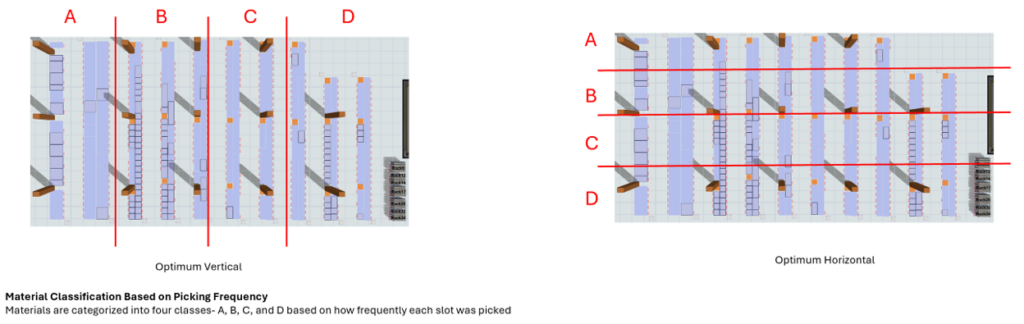
Simulation also plays a critical role in improving slotting strategies for faster and more accurate picking. Warehouses can virtually test different SKU placement strategies based on demand frequency, product category, order profiles, and replenishment patterns. Frequently picked items can be positioned closer to picking zones or dispatch areas, while low-frequency inventory can be strategically relocated to optimize overall warehouse flow. This improves accessibility, reduces congestion, and enhances picking efficiency.
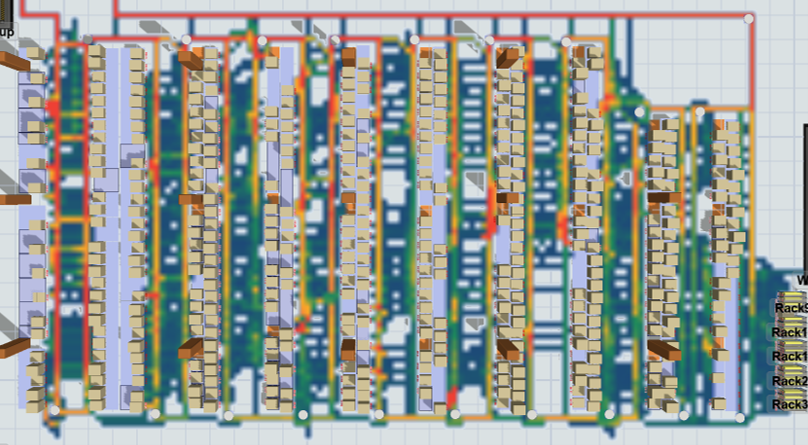
Another important capability of simulation is eliminating congestion through layout testing. Warehouse congestion often occurs in high-traffic aisles, intersections, replenishment areas, and loading zones where pickers, forklifts, and AGVs compete for movement space. Simulation allows organizations to evaluate alternative warehouse layouts, aisle widths, rack configurations, and traffic flow strategies to identify and reduce operational bottlenecks before physical changes are implemented.
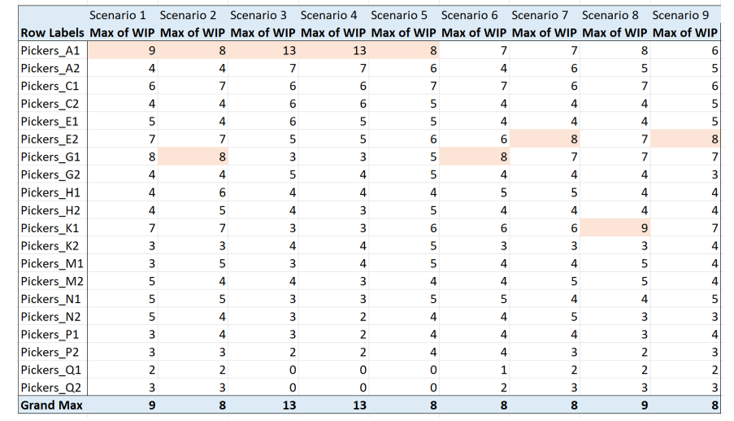
Simulation further supports balancing workloads across zones and shifts by analyzing resource utilization and operational demand patterns. In many warehouses, some picking zones become overloaded while others remain underutilized, leading to delays and inconsistent productivity. Through simulation, organizations can study labor allocation, workload distribution, and shift planning scenarios to achieve more balanced operations and improve overall efficiency.

Modern warehouse operations increasingly involve interactions between multiple resources, making it essential to evaluate AGV, forklift, and human operator coordination. Simulation helps visualize and analyze how automated systems and manual operations interact within shared warehouse spaces. It enables organizations to assess traffic flow, waiting times, collision risks, and resource interference, ensuring smoother coordination between equipment and personnel.
Simulation is also highly effective for testing multiple picking strategies without disrupting live operations. Warehouses can compare the performance of different approaches such as batch picking, zone picking, wave picking, or hybrid picking models under varying order volumes and operational conditions. This allows decision-makers to identify the most suitable picking strategy based on throughput requirements, labor availability, and warehouse configuration.
Another significant advantage is reducing picking errors through process validation. Simulation allows warehouses to evaluate process logic, picking sequences, scanning checkpoints, and material handling workflows before implementation. By identifying error-prone areas and operational inconsistencies early in the planning stage, organizations can improve picking accuracy, reduce returns, and enhance overall order quality.
Overall, simulation transforms warehouse decision-making from assumption-based planning to data-driven operational optimization, enabling organizations to improve picking performance, reduce inefficiencies, and enhance overall warehouse productivity.