
U.S. hospital spending reached $1.6 trillion in 2024, up from $1.4 trillion in 2022, and accounted for 40% of all growth in national health spending over those two years (KFF). With nearly one-third of every healthcare dollar flowing through hospitals, even small workflow inefficiencies, such as an extra walk across a ward, a scanner sitting idle during cleaning, or a supply room that is hard to restock, add up to significant cost and lost capacity.
Hospital workflows are the chains of tasks that connect people, spaces, equipment and supplies: a nurse collecting medications, a technician preparing an MRI room, a porter moving a patient, or a warehouse clerk replenishing a ward. These workflows are rarely designed from scratch. They evolve over years, shaped by building constraints, habits and quick fixes. Simulation provides a structured, data-driven way to see these workflows clearly and redesign them before changing anything in the real hospital.
Key Challenges in Hospital Workflows
Fragmented processes are common. A single patient journey may pass through registration, nursing, diagnostics, pharmacy and transport, each managed by a different team with its own priorities. Handoffs between them create waiting and rework.
Excessive travel and poor layouts waste clinical time. When supply rooms, medication stations and patient rooms are poorly positioned, nurses and physicians spend a meaningful part of each shift walking rather than caring for patients.
Another major concern is unbalanced workloads. Some staff groups operate near full capacity while others have significant idle time, leading to both burnout and wasted labor cost.
Equipment downtime reduces the return on expensive assets. Imaging machines and operating rooms lose valuable minutes to cleaning, setup, late starts and gaps between patients.
Supply chain and logistics inefficiencies affect clinical care directly. Stockouts, manual inventory processes and inefficient picking in hospital warehouses and pharmacies delay treatment and tie up staff.
Finally, new protocols disrupt established workflows. Infection-control rules, new technologies or regulatory requirements can change task times and sequences in ways that are hard to predict.
Sources:
KFF – Hospital spending accounted for 40% of the growth in national health spending, 2022–2024
Sala et al. (2022), Healthcare
How Simulation Optimizes Hospital Workflows
A discrete event simulation model captures each task in a workflow, the resources it requires, how long it takes and how tasks depend on one another. Because the model tracks every person and piece of equipment through time, it reveals where minutes are lost and lets teams test alternatives in a risk-free environment.
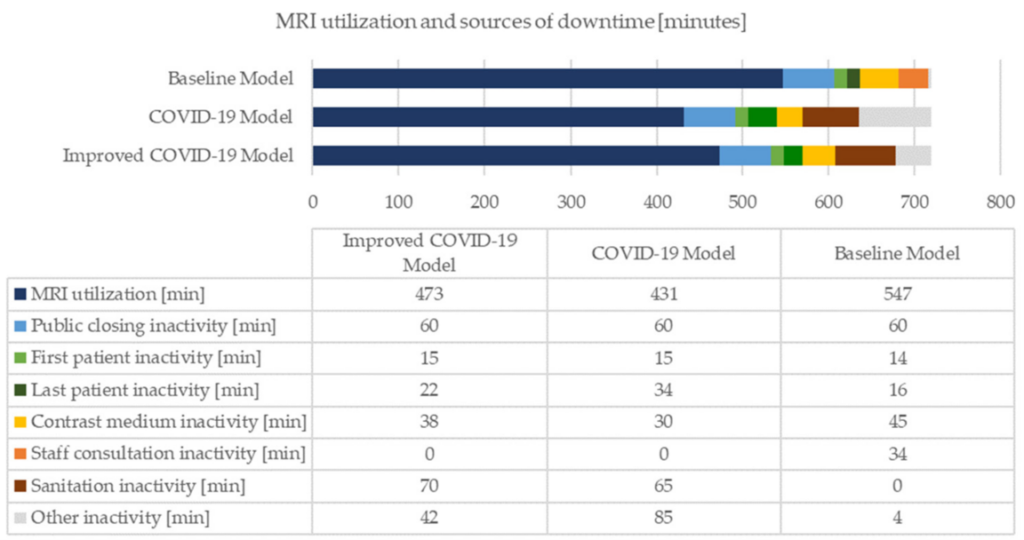
One of the most valuable applications is measuring the hidden cost of new protocols. When an Italian smart clinic introduced COVID-19 sanitation procedures for its MRI service, a FlexSim model showed MRI utilization falling from 547 minutes per day to 431 minutes, with about 65 minutes lost to sanitation. An improved policy recovered part of that capacity, bringing utilization back to 473 minutes while keeping sanitation in place (Sala et al., 2022).
Simulation also plays a critical role in combining lean thinking with data. Lean tools identify waste, while simulation quantifies it and tests the improvements. At a Brazilian colonoscopy centre, researchers combined lean production and DES, using dashboards to track physician occupancy and walking distance across a simulated shift (Bócoli et al., 2024). Lean-plus-simulation approaches have also been applied to healthcare logistics and pharmacy operations (Dossou et al., 2020).
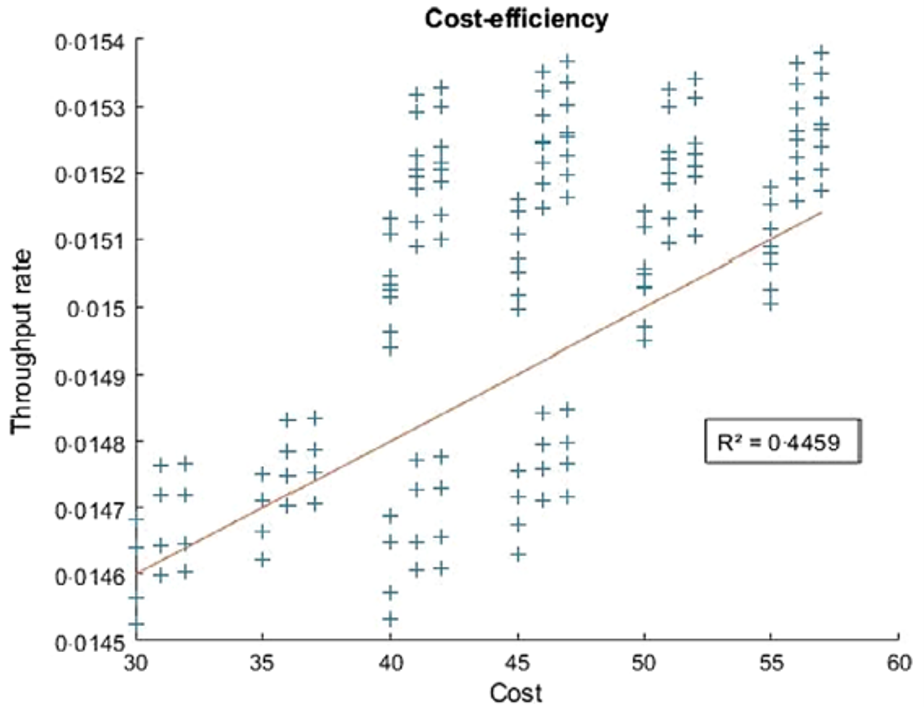
Another important capability is optimizing support services and logistics. A FlexSim model of a blood donation centre in Italy evaluated cycle times, the utilization of nurses, clerks and physicians, and bed utilization, then compared configurations on cost-efficiency so managers could see which changes increased donor throughput for the money spent (Doneda et al., 2021).
Simulation further supports hospital warehouse and inventory design. A study of a hospital warehouse in Feira de Santana, Brazil, used simulation to analyze employee states and travel distance, revealing low staff utilization and opportunities to reorganize work (Cerqueira et al., 2025). Others have designed fully automated, integrated inventory and replenishment systems for hospitals (Jebbor et al., 2023). Many of the same techniques used in industrial warehouses, such as slotting, route optimization and workload balancing, apply directly to hospital supply rooms.
Modern hospitals increasingly include automation, which makes it essential to evaluate robot and human coordination. Researchers developing tele-operated mobile robots for COVID-19 field hospitals used simulation to analyze robot states (idle, travelling empty, travelling loaded, loading and unloading) and staff utilization, sizing the fleet before deployment (Vongbunyong et al., 2021).
Simulation is also highly effective for layout and space planning. Facility design studies have linked simulation with optimization algorithms to arrange multiple departments, evaluating length of stay, staff utilization, room occupancy and financial performance across layouts (Hao et al., 2024). Operating room layout studies use the distance travelled by staff as a direct measure of workflow efficiency (Khantasit & Srithorn, 2025); (Doneda et al., 2026).
Finally, simulation supports balancing work across teams and shifts. By reporting the time each staff group spends providing care, travelling, waiting and idle, models help managers redistribute tasks so no group is consistently overloaded.
Overall, simulation turns hospital workflow improvement from trial-and-error into evidence-based design. It exposes hidden waste, quantifies the effect of each proposed change, and helps hospitals recover time for what matters most: patient care.