
Operating rooms are among the most expensive spaces in any hospital. A widely cited study of California hospitals estimated the mean cost of OR time at about $36 to $37 per minute, with wages, benefits and direct costs making up most of that figure (AJMC summary of Childers & Maggard-Gibbons, JAMA Surgery 2018). Across the 20 U.S. hospitals with the highest OR costs, total operating room costs averaged about $302 million per hospital (Definitive Healthcare). At those prices, every idle minute, late start or slow turnover represents real money and lost surgical capacity.
Operating room performance depends on the coordination of surgeons, anesthesiologists, nurses, technicians, equipment, sterile supplies and pre- and post-operative beds. Surgical durations are uncertain, emergencies interrupt schedules, and a delay in one case cascades through the rest of the day. Because ORs are so costly and so safety-critical, hospitals cannot afford to experiment with layouts or schedules on live patients. Simulation offers a way to test these decisions virtually and choose the best option with confidence.
Key Challenges in Operating Room Utilization
Uncertain surgical durations are the biggest source of disruption. Cases routinely run longer or shorter than planned, causing overtime, idle gaps or cancellations.
Scheduling complexity adds to the problem. Building a schedule that balances surgeon preferences, equipment availability, staff shifts and recovery bed capacity is a difficult combinatorial task.
Another major concern is turnover and setup time. Cleaning, room preparation and equipment setup between cases consume valuable OR minutes, especially for complex procedures such as robotic surgery.
Staff idleness and overload coexist. Some nursing roles may be idle for long periods while others are stretched, depending on case mix and schedule design.
OR layout and equipment placement influence how far staff walk, how easily robotic systems and imaging equipment can be positioned, and how smoothly the team works together.
Finally, downstream capacity constraints in pre-operative areas and post-anesthesia care units (PACU) can block patients from entering or leaving the OR on time.
Sources:
Childers & Maggard-Gibbons (2018), JAMA Surgery
Definitive Healthcare – Hospitals with the highest operating room costs
How Simulation Improves Operating Room Utilization
A discrete event simulation model of the perioperative process represents patient preparation, transport, anesthesia, surgery, turnover and recovery, along with the staff and equipment required at each step. It captures the variability in case durations and lets planners measure total process time, staff utilization, idle time, patient waiting time and walking distance under any proposed change.
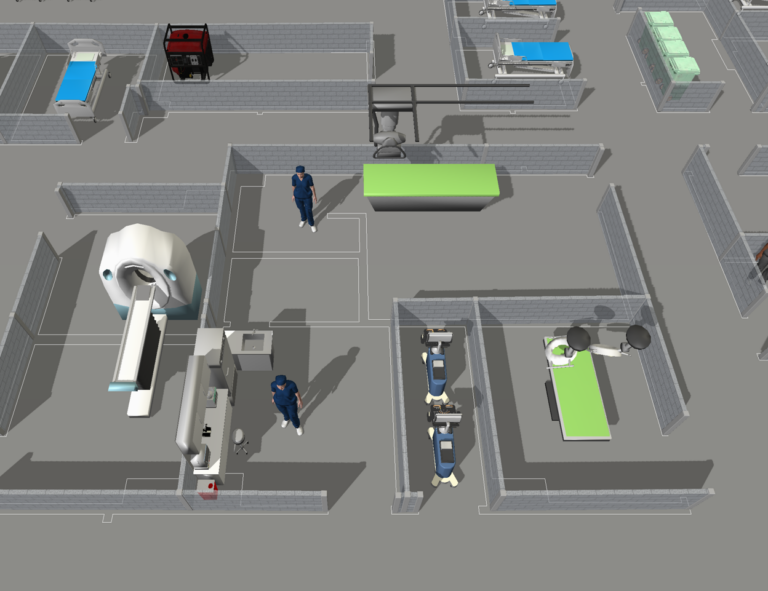
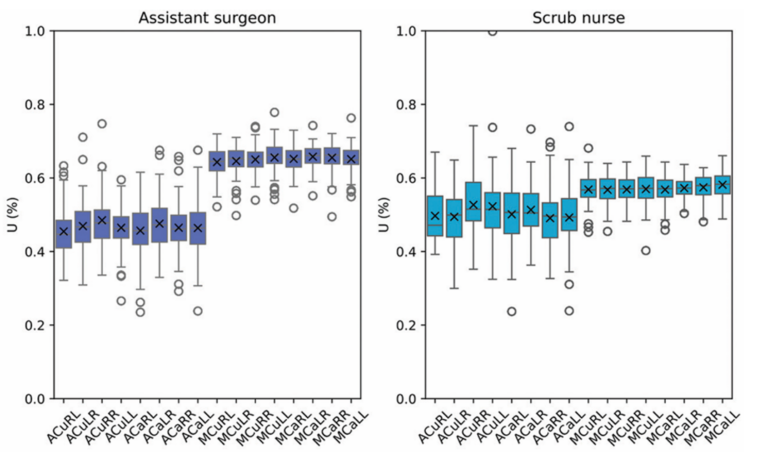
One of the most valuable applications is configuring OR layouts before construction or relocation. At Humanitas Gavazzeni Hospital in Bergamo, Italy, researchers recorded activity and timing data for every operator during robotic cardiac surgery and built a DES model covering atrial fibrillation ablation and mitral valve repair. The model compared OR layouts, including the characteristics of a new, larger OR before the team moved into it, using total process time, staff utilization and distance covered by the surgical team as KPIs. The authors’ recommendations were applied in practice (Doneda et al., 2026).
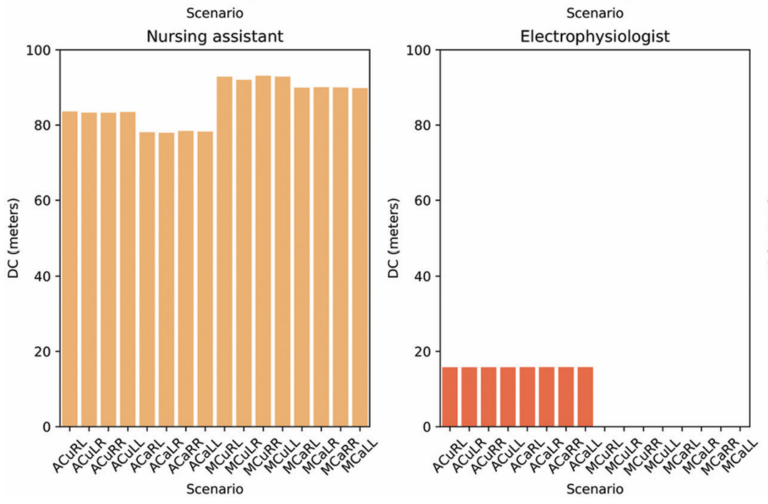
Simulation also plays a critical role in reducing staff walking and improving ergonomics. In the same study, bar plots of the distance covered by nursing assistants and electrophysiologists across scenarios showed how layout choices change the physical workload on each team member (Doneda et al., 2026). An OR layout study at Wang-Noi Hospital in Thailand similarly used time metrics, distance travelled and staff utilization to enhance surgical efficiency (Khantasit & Srithorn, 2025).
Another important capability is measuring the impact of uncertainty on patient waiting. A simulation study of an operating room process compared four levels of uncertainty in surgical times. With no uncertainty, average patient waiting time was about 75 minutes, but under strong uncertainty it rose to around 110 minutes, showing why schedules built on fixed durations break down in practice (Rifi et al., 2022).
Simulation further supports optimizing staffing and reducing idle time. A three-stage approach combining nonlinear programming with simulation evaluated idleness for pre-operative nurses, PACU nurses, circulating nurses, scrub nurses and maintenance technicians across scenarios, helping identify staffing levels that reduce idle time without hurting performance (Gabriel et al., 2025).
Modern OR planning increasingly uses simulation-optimization for surgical scheduling. Multi-objective scheduling approaches pair a simulation model with heuristic algorithms and design of experiments to balance OR utilization, overtime and patient waiting (Yang et al., 2023). Instead of relying on a single deterministic schedule, planners can evaluate how a proposed schedule performs across hundreds of realistic days.
Simulation is also highly effective for testing turnover and block-scheduling strategies. Hospitals can compare parallel induction, dedicated turnover teams, different block allocations and add-on case policies, and see how each one affects first-case on-time starts, utilization and overtime.
Overall, simulation helps hospitals unlock more value from their most expensive resource. It supports better layouts, smarter schedules and balanced staffing, increasing surgical throughput and reducing overtime while protecting patient safety.