
More than 138,000 nurses have left the U.S. workforce since 2022, and 39.9% of registered nurses and 41.3% of licensed practical and vocational nurses say they plan to leave or retire within the next five years. Among nurses who intend to leave for reasons other than retirement, about 41.5% point to stress and burnout as the root cause (NCSBN 2024 National Nursing Workforce Study).
Burnout is not only a personal problem; it is an operational one. Emotional exhaustion, disengagement and reduced empathy toward patients diminish the quality of care and make it harder for hospitals to retain staff (Sipos et al., 2024). While burnout has many causes, poorly designed workflows are among the most controllable. Excessive walking, unbalanced assignments, constant interruptions and chronic understaffing at peak hours wear nurses down shift after shift. Workflow simulation gives hospitals a way to see and fix these problems before they drive people out of the profession.
Key Workflow Drivers of Nurse Burnout
Unbalanced workloads are a major factor. In many units, some nurses are consistently overloaded while others have more idle time, depending on patient assignments, unit layout and shift patterns.
Staffing that does not match demand creates chronic pressure. When schedules are based on averages, peak hours leave nurses stretched thin while quieter hours may be overstaffed.
Another major concern is excessive walking and non-value-added tasks. Poorly located supply rooms, medication stations and equipment force nurses to spend significant time travelling instead of caring for patients.
Physically demanding tasks such as patient transfers and transport add to fatigue and injury risk.
New protocols and crisis conditions, such as infection-control procedures during a pandemic, can add tasks without adding staff.
Finally, high-stakes emergencies like evacuations place enormous demands on nursing staff, and inadequate staffing ratios can have life-or-death consequences.
Sources:
NCSBN – 2024 National Nursing Workforce Study release (April 2025)
How Workflow Simulation Helps Reduce Burnout
Workflow simulation models every task nurses perform, how long each takes, where it happens and how tasks compete for the same people. The model reports how each staff member spends their time (providing care, travelling, waiting or idle), making workload visible in a way that schedules and timesheets cannot.
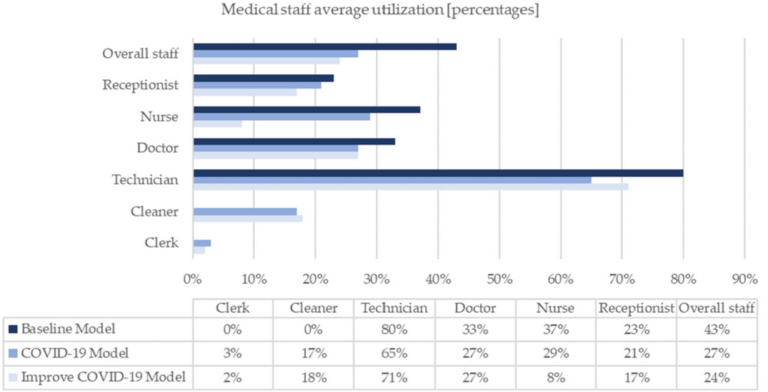
One of the most valuable applications is making workload visible and measurable. In a simulation of an MRI smart clinic, nurse utilization was 37% in the baseline model and 29% under the initial COVID-19 policy. In the improved model, nurse utilization dropped to about 8%, while technicians stayed above 70% and cleaning staff took on new sanitation work, showing exactly how workflow design shifts the load between staff groups (Sala et al., 2022). Studies of hospital care efficiency report similar staff utilization profiles for general consultation nurses, emergency nurses, physicians and technicians, revealing which groups carry the most load (Osorio-Canchig et al., 2025).
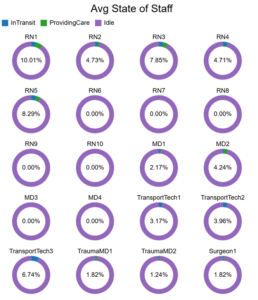
Simulation also plays a critical role in reducing walking distance. FlexSim models track the distance each staff member travels during a shift. In operating room studies, comparing layouts showed large differences in the distance covered by nursing assistants (Doneda et al., 2026), and dashboards in a colonoscopy centre tracked the total distance walked by physicians over a simulated shift (Bócoli et al., 2024). Reducing unnecessary walking frees time for patient care and reduces physical fatigue.
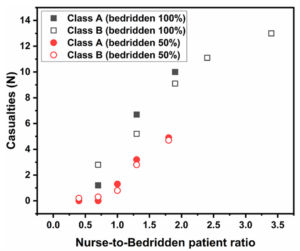
Another important capability is right-sizing staffing for safety. A study of nursing personnel operations during medical facility fires combined fire dynamics modeling with FlexSim Healthcare evacuation simulation. As each nurse became responsible for more bedridden patients, simulated casualties rose sharply, giving hospitals evidence-based guidance on the staffing ratios needed to evacuate patients safely (Kim et al., 2024).
Simulation further supports evaluating technology that offloads physical work. A digital twin of a nurse-following, negative-pressure bed robot for transporting infectious patients used a FlexSim ward model to measure staff handling time and walking distance across scenarios, a step toward reducing physically demanding transport tasks for nurses (Woo et al., 2025).
Modern approaches also balance staffing and idle time with optimization. Combining nonlinear programming with simulation, researchers evaluated idleness for pre-operative nurses, PACU nurses, circulating nurses and scrub nurses, identifying staffing levels that avoid both overload and excessive idle time (Gabriel et al., 2025). In emergency departments, simulation-based design of experiments has been used to determine nurse and physician counts by shift (Gabriel et al., 2020).
Simulation is also highly effective for testing scheduling and assignment strategies. Hospitals can compare shift lengths, staggered start times, float pools, patient assignment rules and team nursing models, and see how each one affects peak workload, overtime and patient waiting time.
Overall, workflow simulation gives hospitals an objective, data-driven way to address one of the root causes of nurse burnout. By making workload visible, reducing wasted motion and matching staffing to real demand, simulation helps create safer, more sustainable working conditions for nurses and better care for patients.