
The digital twins in healthcare market was valued at about $4.47 billion in 2025 and is projected to reach about $101.19 billion by 2031, a compound annual growth rate of about 68.4% (MarketsandMarkets). The growth reflects a simple idea with powerful implications: if a hospital has a living virtual copy of its operations, it can predict problems, test responses and make better decisions in real time.
Hospitals already generate large amounts of operational data, including patient arrivals, bed status, staff schedules, equipment usage and timestamps in electronic health records. Most of that data is used to report what already happened. A digital twin connects that data to a simulation model, turning it into a tool for understanding what will happen next and what to do about it.
What Is a Healthcare Digital Twin?
A digital twin is a virtual representation of a physical system that is continuously or regularly updated with real-world data. In healthcare operations, the physical system might be an emergency department, an inpatient ward, an operating suite or an entire hospital. The twin mirrors the current state of the system and can run forward in time to forecast demand, test scenarios and recommend actions.
Discrete event simulation is the engine behind most operational digital twins. The simulation model captures how patients, staff and resources interact, while live data keeps the model aligned with reality. Advanced twins add machine learning for prediction, optimization algorithms for recommendations, and IoT sensors or robotics for real-time tracking.
Key Challenges Driving the Need for Digital Twins
Real-time uncertainty is the defining challenge. Hospital managers must make decisions about staffing, bed assignments and patient transfers every hour, often without a clear view of what the next few hours will bring.
Disconnected data systems limit insight. Bed management, scheduling, EHR and equipment systems often operate in silos, making it hard to see the full picture.
Another major concern is surge and crisis readiness. Pandemics, disasters and seasonal peaks require rapid decisions about capacity, transfers and staffing.
Static planning models quickly become outdated. A simulation built once for a project may not reflect changes in demand, staffing or layout a year later.
Finally, infection control and staff safety demand new ways of moving and monitoring patients, especially those with infectious diseases.
Sources:
MarketsandMarkets – Digital Twins in Healthcare Market
How Digital Twins Are Transforming Hospital Operations
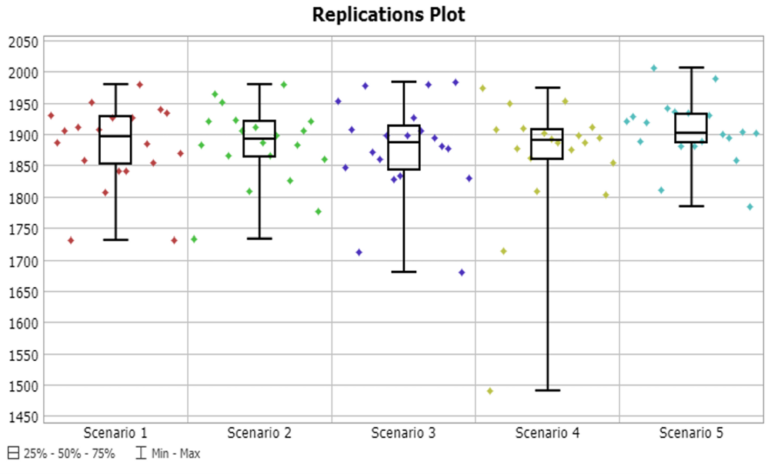
One of the most promising applications is federated digital twins for patient transport. Korean researchers built a digital twin of a nurse-following, negative-pressure bed robot that transports infectious disease patients. The system used separate, linked twins for the patient, the robot and a central control centre, connected through HL7 FHIR. A FlexSim model of a COVID-19 inpatient ward at Ilsan Hospital was run across five scenarios with 20 replications each to measure length of stay, staff handling time and staff walking distance, and expert reviewers scored the system 92.46 out of 100. The authors noted that differences between scenarios were not statistically significant at the light workload simulated, which itself is a useful finding: it shows where further testing under heavier demand is needed (Woo et al., 2025).
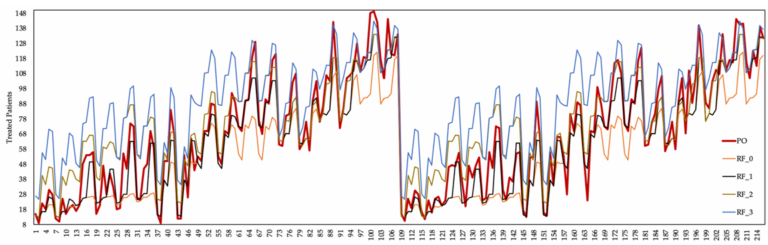
Digital twins also play a critical role in predicting demand and waiting times with machine learning. Researchers integrated FlexSim simulation with Random Forest, Gradient Boosting and AdaBoost algorithms to predict ED waiting time and the number of patients treated, and to estimate the cost of healthcare resources (Atalan et al., 2022). Once trained, these predictive layers allow a twin to forecast crowding hours ahead.
Another important capability is monitoring process stability. Integrating DES with statistical process control lets a twin track patient waiting time on X-bar and R control charts, flagging when the process drifts outside normal limits (Atalan, 2023).
Digital twins further support learning from real operational data. Big-data simulations built from EHR timestamps in an ophthalmology clinic demonstrated how routinely collected data can drive realistic capacity models without manual time studies (Kern et al., 2021). Similar data-driven models have been used to design person-centered workflows for high-throughput breast MRI screening (Kočo et al., 2024).
Twins are also highly effective for pandemic and regional capacity management. Simulation frameworks for strategic patient relocation track how many patients each hospital in a network can serve and the cumulative transfer cost over time, supporting decisions about where to send patients during surges (Tabatabaee et al., 2025). Models of temporary hospitals during COVID-19 helped determine bed counts and staffing needed to meet length-of-stay targets (Campos et al., 2022).
Finally, digital twins enable continuous simulation-optimization. Frameworks that combine simulation with response surface methodology and goal programming can recommend staffing changes that balance waiting time and utilization (Baesler et al., 2025). When connected to live data, these frameworks move from one-time studies to ongoing decision support.
Building Toward a Smart Hospital
Most hospitals do not need to start with a fully connected, real-time twin. A practical path looks like this:
- Start with a validated simulation model of one high-impact area, such as the ED or OR suite.
- Connect historical data from EHR and scheduling systems to keep inputs current.
- Add forecasting with machine learning to predict arrivals and length of stay.
- Introduce near-real-time feeds for bed status and staffing, and use the model for daily huddles.
- Scale to multiple departments and link them into a hospital-wide twin.
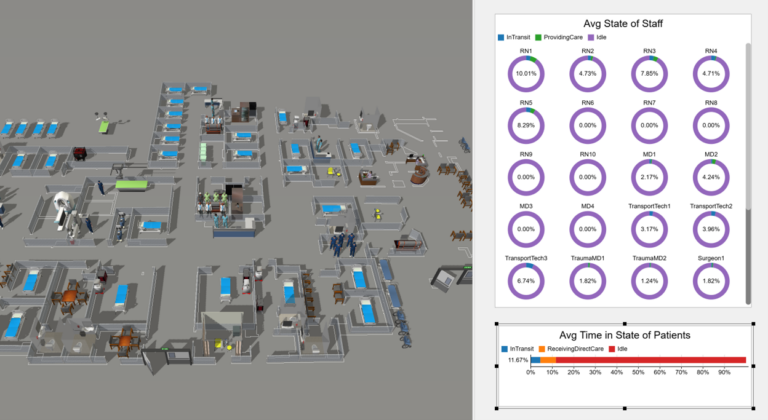
Overall, healthcare digital twins represent the next step in hospital operations: from looking back at reports to looking ahead with simulation. Built on proven discrete event simulation methods, they help hospitals anticipate demand, test decisions instantly and operate as truly smart, resilient organizations.