
Emergency departments in the United States handle about 155.4 million visits a year, yet only 40.6% of patients are seen by a provider within 15 minutes of arrival (CDC FastStats). According to CMS data for October 2024 to September 2025, the median time a patient spends in the ER before leaving is about 162 minutes, unchanged from the previous year. Visit times vary widely, from about 110 minutes in North Dakota to 303 minutes in Washington, D.C. (Axios).
Emergency care is uniquely unpredictable. Patients arrive without appointments, with severity ranging from minor injuries to life-threatening conditions, and each case requires a different combination of staff, tests and beds. When demand outpaces capacity, waiting rooms fill up, patients leave without being seen, and clinicians work under intense pressure. ED overcrowding is now recognized as both a public health issue and a patient safety concern. Because emergency departments cannot pause operations to test new ideas, simulation has become one of the most practical ways to redesign them safely.
Key Challenges Behind Long ER Wait Times
Emergency department crowding has many interconnected causes, and fixing one in isolation often moves the bottleneck elsewhere.
Unpredictable patient arrivals are the starting point. Arrivals spike at certain hours, days and seasons, and mass gatherings or outbreaks can create sudden surges. Staffing plans based on averages leave the department exposed during peaks.
Triage and registration bottlenecks slow patients at the front door. When there are too few triage nurses or the registration process is sequential, queues form before care has even started.
Another major contributor is boarding and limited inpatient bed capacity. Admitted patients who cannot be moved to a ward occupy ED beds for hours, blocking new arrivals.
Delays in ancillary services such as imaging, laboratory testing and specialist consultations further extend each patient’s stay, even when the ED itself has capacity.
Staffing mismatches also play a role. Physicians, nurses and porters may be scheduled in patterns that do not match hourly demand, leaving some periods understaffed and others overstaffed.
Finally, waiting room layout and patient routing influence how efficiently patients move from arrival to triage to a treatment space. Poor layouts create extra walking, confusion and delays in room placement.
Sources:
CDC FastStats – Emergency Department Visits
Axios – Americans spend more than 2.5 hours in the ER (CMS data)
How Simulation Reduces ER Wait Times
Discrete event simulation recreates the emergency department in a virtual environment, including patient arrival patterns by hour and acuity, triage rules, treatment pathways, staff schedules, bed counts and links to imaging, labs and inpatient units. Decision-makers can then test changes and measure their impact on waiting time, length of stay and the number of patients treated before anything changes on the floor.
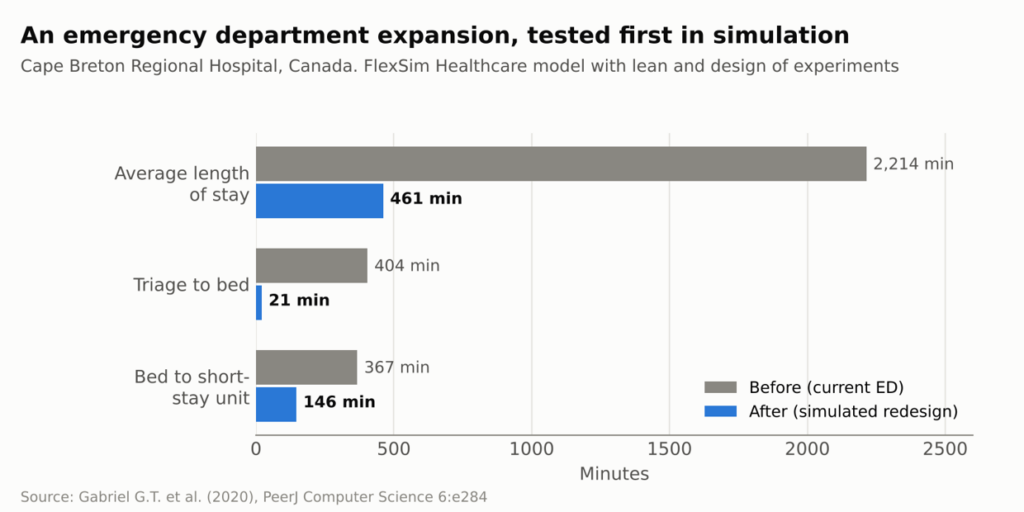
One of the most valuable applications is right-sizing beds and staff before an expansion. When four nearby small centres closed and their patients shifted to Cape Breton Regional Hospital in Canada, the team built a FlexSim Healthcare model of the ED using a full year of arrival data. Combining lean thinking with design of experiments, they tested bed counts and staffing by shift. The chosen scenario increased short-stay unit beds from 10 to 30, added a triage nurse, an ED nurse and four porters, and reduced the physician count by two. In the model, average length of stay fell by about 79%, time from triage to bed dropped from 404 minutes to 21 minutes, and the share of patients treated rose from 17.2% to 95.7% (Gabriel et al., 2020).
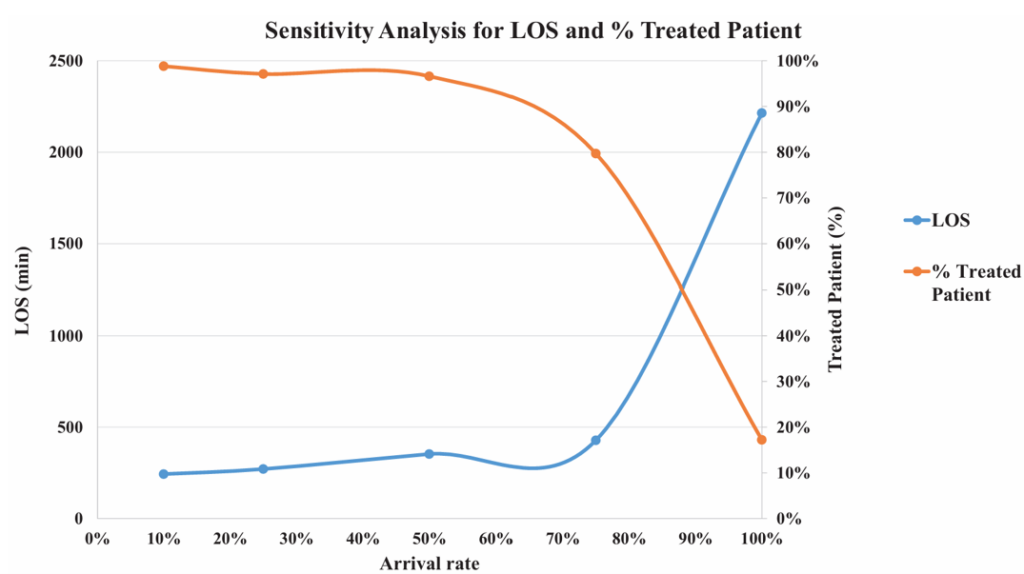
Simulation also helps stress-test the department against demand surges. In the same study, the model was run at arrival levels from 10% to 100% of expected demand. Length of stay stayed low at moderate loads but rose sharply once arrivals passed about 75%, while the share of treated patients collapsed. Knowing where that tipping point lies helps managers plan surge staffing in advance.
Another important capability is planning for mass-gathering events. Researchers modeled an emergency room serving pilgrims during Hajj, one of the largest annual gatherings in the world, and compared five operating scenarios. The best-performing scenario reduced average patient stay time from roughly 130 minutes to under 80 minutes in the model (Hijry & Olawoyin, 2022).
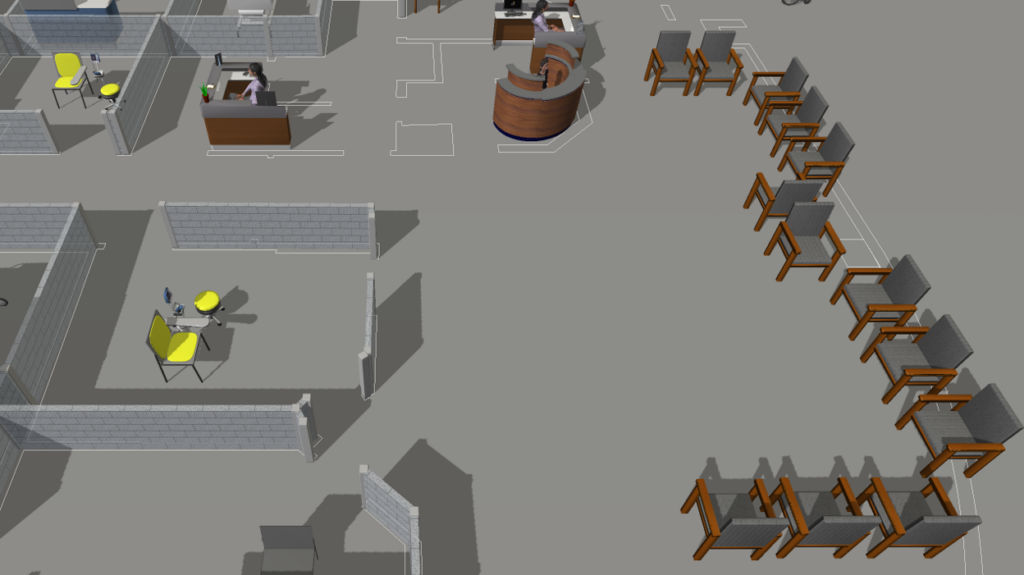
Simulation supports redesigning waiting rooms and patient routing. At the University of Virginia, a FlexSim model was used to evaluate a new ED waiting room layout, tracking arrival-to-triage time, triage-to-room placement and arrival-to-room placement to improve patient flow and satisfaction (Dahlquist et al., 2025). Similar layout-and-process studies have shown how design changes and process changes work together to reduce delays (Zamani, 2022).
Modern models also combine simulation with optimization and machine learning. Multi-objective frameworks pair FlexSim with response surface methodology and goal programming to balance waiting time against staff utilization (Baesler et al., 2025), while other studies feed simulation output into Random Forest, Gradient Boosting and AdaBoost models to predict waiting times and the number of patients treated (Atalan et al., 2022). Screening experimental designs help identify which factors, such as the number of doctors, nurses or beds, actually move the needle (Atalan & Dönmez, 2020).
Simulation is also highly effective for testing triage and fast-track strategies. Teams can compare split-flow models, provider-in-triage, dedicated fast-track lanes for low-acuity patients, or results-pending areas, and see how each one affects door-to-provider time and overall length of stay under realistic arrival patterns.
Overall, simulation gives emergency departments a safe place to experiment. It identifies the true constraints behind long waits, quantifies the effect of every proposed change, and helps leaders invest in the staff, beds and layout changes that will actually reduce wait times.