
National health spending in the United States reached $5.3 trillion in 2024, about 18% of GDP, and hospital care alone accounted for $1.6 trillion of it. Hospital spending also grew faster than total health spending in both 2023 and 2024 (KFF analysis of CMS National Health Expenditure data). At the same time, emergency departments recorded about 155.4 million visits in a single year (CDC FastStats), and the national median time a patient spends in the ER sits at roughly 162 minutes (Axios analysis of CMS data, 2024–2025). The broader healthcare simulation market, valued at about $3.53 billion in 2025, is projected to grow to roughly $12.94 billion by 2034 at a CAGR of about 15.5% (Towards Healthcare).
Hospitals are among the most complex operating environments that exist. Patient arrivals are unpredictable, treatment times vary from case to case, and every patient pathway depends on shared and limited resources: beds, nurses, physicians, imaging equipment and operating rooms. A delay at registration, triage, imaging or discharge ripples across the entire system, creating crowding, longer stays, staff fatigue and higher costs. Unlike a factory, a hospital cannot simply shut down a unit to experiment with a new layout or staffing model, because patient safety is always on the line. That is exactly why healthcare simulation has become such a valuable decision-making tool.
What Is Healthcare Simulation?
The term “healthcare simulation” covers two different worlds. Clinical simulation uses mannequins, virtual reality and standardized patients to train clinicians. Operational simulation, the focus of this article, builds a computer model of a hospital process, such as an emergency department, outpatient clinic, operating suite or pharmacy, and uses it to test how the system behaves under different conditions.
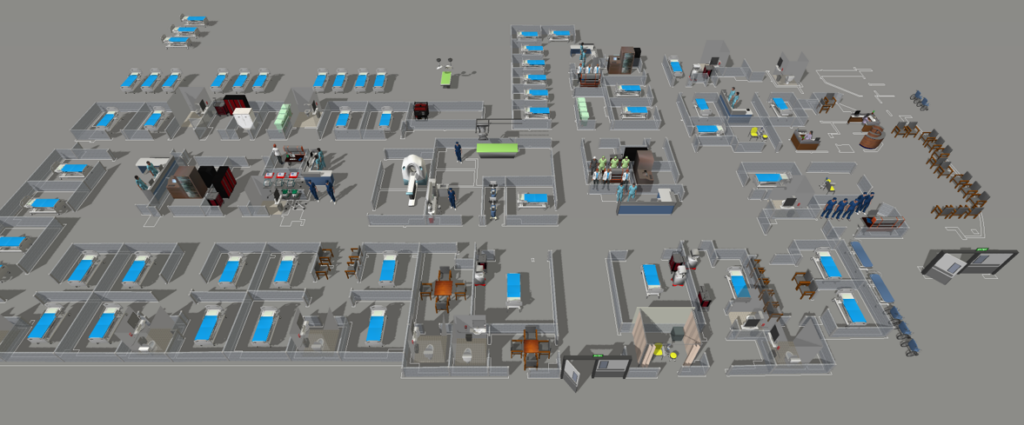
The most widely used operational technique is Discrete Event Simulation (DES). A DES model represents patients as entities moving through a sequence of events (arrival, registration, triage, consultation, testing, treatment and discharge), each of which consumes resources and time. Because the model captures randomness in arrivals and service times, it can reproduce the queues, bottlenecks and idle periods that occur in a real hospital (Forbus & Berleant, 2022; Vázquez-Serrano et al., 2021). Tools such as FlexSim Healthcare add a 3D visual layer, so clinicians and administrators can literally watch patients and staff move through a virtual version of their own facility.
Key Challenges That Make Hospitals Hard to Manage
Hospitals face a set of interconnected operational challenges that are difficult to solve with spreadsheets or intuition alone.
Overcrowding and long waiting times are the most visible problem. Delays in registration, triage bottlenecks, slow discharge and queues for imaging or specialist consultations all add up, reducing patient satisfaction and in some cases worsening clinical outcomes.
Another major concern is rising costs and financial pressure. Hospitals must control expenses while maintaining quality and safety. Inefficient processes lead to resource waste, unnecessary patient days, overtime expenses and idle equipment.
Staff shortages and burnout add further strain. Poorly balanced workflows push some staff into constant overload while others sit underutilized, contributing to fatigue, emotional exhaustion and turnover (Sipos et al., 2024).
Hospitals also struggle with capacity and length of stay (LOS). Extended stays reduce bed availability, block patient flow from the emergency department and raise the risk of hospital-acquired infections (Hirani et al., 2025).
Finally, the COVID-19 pandemic exposed the need for surge readiness. Shortages of ICU beds, ventilator allocation problems, staff overload and supply chain disruptions showed how quickly a hospital can be pushed past its limits (Filip et al., 2022).
Sources:
KFF – Hospital spending accounted for 40% of the growth in national health spending, 2022–2024
CDC FastStats – Emergency Department Visits
Sipos et al. (2024), The Lancet Regional Health – Europe
Why Hospitals Need Simulation
Simulation gives hospital leaders a risk-free virtual environment in which to ask “what if?” before committing money, space or staff to a change. Its benefits span several dimensions, from day-to-day operations to long-term strategy.
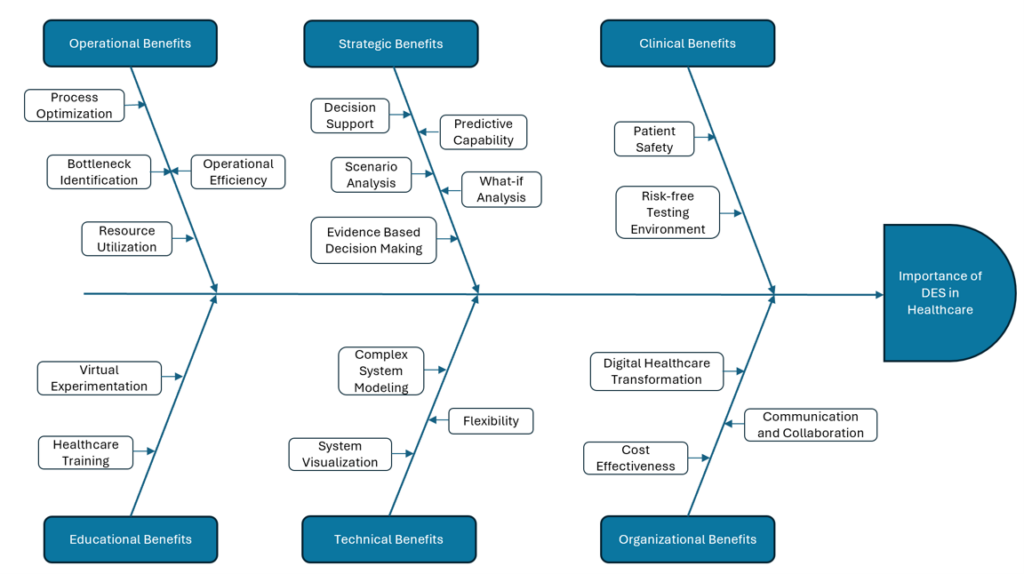
Testing changes without risking patients. New layouts, staffing plans, triage rules or appointment templates can be evaluated in the model first. If a change fails, it fails on a computer screen rather than in a waiting room.
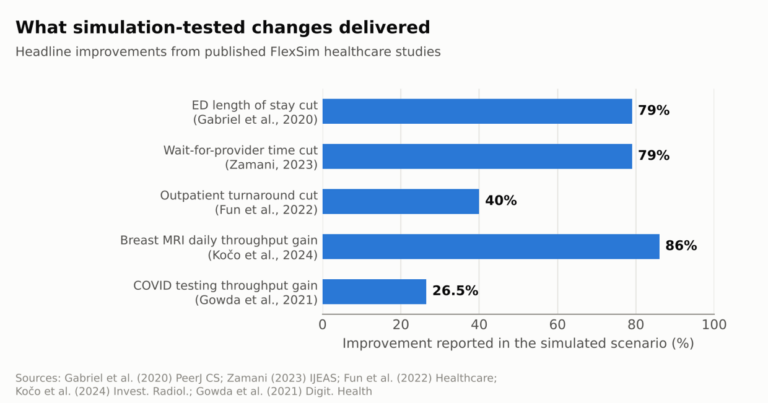
Finding the real bottleneck. Intuition often points to the wrong constraint. In a COVID-19 screening facility in New Delhi, a FlexSim model showed that kit preparation was the true bottleneck; adding three staff at that step raised daily capacity from 316 to 400 patients, an increase of about 26.5%, and the change was implemented on the ground (Gowda et al., 2021).
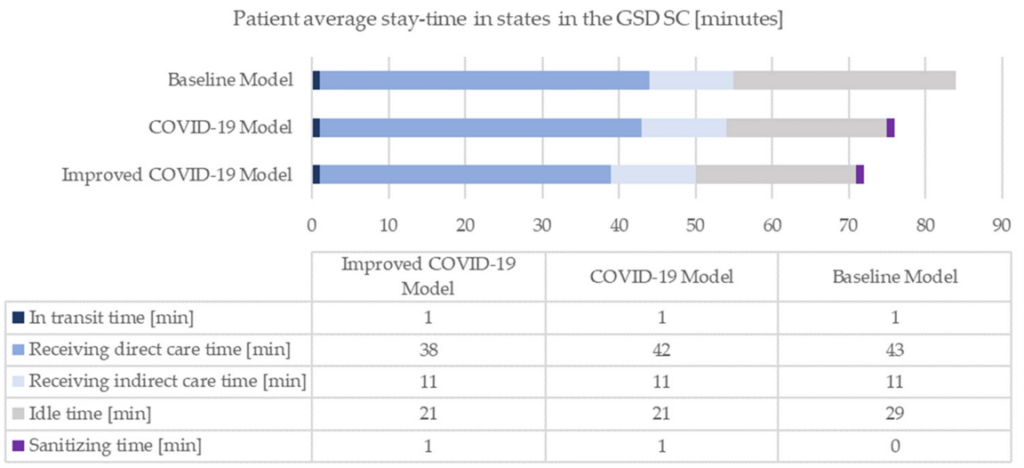
Quantifying the trade-offs. Simulation turns arguments into numbers. When an Italian smart clinic introduced COVID-19 sanitation policies for its MRI service, a DES model showed exactly how much scanner time was lost to cleaning and how an improved policy could recover part of it while reducing patient stay time (Sala et al., 2022).
Planning capacity with confidence. A Canadian emergency department used FlexSim with lean principles and design of experiments to plan an expansion. The selected scenario cut average length of stay from about 2,214 minutes to 461 minutes and raised the share of patients treated within the simulated period from 17.2% to 95.7% (Gabriel et al., 2020).
Communicating with clinicians. A 3D animated model is far easier to discuss with nurses, physicians and executives than a table of queueing formulas. Seeing their own department on screen builds trust in the results and speeds up buy-in.
Supporting training and preparedness. The same models can be used to rehearse surges, evacuations and pandemic scenarios, helping staff understand how the system behaves under pressure.
Where Simulation Is Being Applied
Recent FlexSim-based studies cover almost every corner of the hospital:
- Emergency departments: triage, patient routing, staffing and waiting room design (Gabriel et al., 2020); (Dahlquist et al., 2025)
- Outpatient clinics and imaging: appointment templates, consultation start times and MRI throughput (Fun et al., 2022); (Kočo et al., 2024)
- Operating rooms: OR layout, surgical team coordination and scheduling (Doneda et al., 2026); (Yang et al., 2023)
- Hospital logistics: warehouses, blood donation centres, pharmacies and delivery robots (Doneda et al., 2021); (Vongbunyong et al., 2021)
- Pandemic and disaster planning: temporary hospitals, patient relocation and evacuation staffing (Campos et al., 2022); (Kim et al., 2024)
- Facility design: department layouts, room counts and capacity planning (Hao et al., 2024)
Overall, healthcare simulation shifts hospital decision-making from assumption-based planning to evidence-based improvement. It allows organizations to reduce waiting times, use staff and equipment more effectively, plan capacity with confidence and protect patient safety, all before a single wall is moved or a single shift is changed.